
MARA
MARA is a circular design system that transforms shellfish debris into functional ceramic material, reimagining a waste stream produced by the seafood industry as a resource for local craftspeople. Developed through iterative material testing and critical reflection, the project addresses a real-world environmental issue of marine waste whilst proposing a scalable, decentralised model for sustainable material production.
The system includes equipment designed to facilitate shellfish waste collection, targeted at ceramicists working in Scottish coastal communities.
This portfolio documents the development of the system in its research, failures, and refinements, demonstrating a design methodology rooted in empirical experimentation and critical assessment. It reflects on the limitations and the opportunities of waste reuse, questioning assumptions around sustainability and the role of design in shaping future material economies.


Scotland’s seafood industry produces monumental volumes of shell waste from mussels, oysters, and crabs — most of which is discarded. Shells decompose slowly, with over 10,000 tonnes produced in 2023 alone. One seafood restaurant can throw away over 3 tonnes annually; a facility in Eyemouth send hundreds of tonnes of crab shell to landfill each year.
Shell waste creates environmental issues: it’s slow to break down, emits CO₂ when incinerated, and can cause odour and pest issues. Due to shellfish waste being classed as “animal by-product,” a licence is required to disposing large amounts. This can be costly for small businesses.
Despite these issues, shell material has great potential. This project aims to intercept and revalue this overlooked waste stream through decentralised design and industrial symbiosis.


I collected shellfish waste from various stages of the seafood industry: seafood restaurants, wholesale fish markets, and fishmongers. I collected a range of species including crab, mussel, lobster, oyster, and scallop.
I then processed the shell waste, breaking it down into an aggregate that can be mixed into natural binding materials such as bio-resins and clays. This aggregate built the foundation of my material experimentation.

To explore the potential of the shellfish aggregates in product applications, I developed a series of test tiles by mixing different types of ground shell with a variety of clay bodies.
I experimented with many variables, such as the choice of clay, glaze, shellfish particulate size, and surface texture. I also changed the thickness of the material to assess how the structural integrity is effected by certain variables.
After producing the samples, I conducted material testing to record strength, durability and surface quality. A key finding from the tests was that strength performance remained very high when the aggregate size was under 1mm and lower than 17.5% by weight.
The final material is made from 7.5% shellfish waste, and 92.5% British stoneware clay.


I waned my brand name to derive from Scottish coastal mythology, drawing on rich narratives of maritime spirits and mythical beings.
The word ‘Mara’ emerged as a great choice. Frequently referenced in Scottish coastal poetry and literature, ‘Mara’ refers to enchanted ocean beings, associated with Mither o’ the Sea, a spirit responsible for calming turbulent waters. This resonates with my project goals, while connecting to Scottish folklore, enhancing the narrative of my material.
When making my logo, I decided to take inspiration from Pictish symbols. Between 300-900 CE the Picts created intricate carvings that remain significant in Scottish cultural heritage. I borrowed aspects of their visual language, creating a simple mark using just straight, but imperfect lines.

System Proposal:
The system will empower coastal ceramicists to craft with my developed material. I will develop a shellfish waste collection system. The ceramic studio will be facilitated with this collection infrastructure, in return for a 10% commission per sale on a decentralised website.

The system will be designed to be extremely simple, making it replicable in other coastal Scottish communities. The model will be able to fit into any ceramic studio. Adding to this, the local material inputs – shellfish variation mixed with local clay bodies – will alter the aesthetics of the final products, reaffirming the cultural heritage embedded into each site-specific piece.
I designed a digital base for MARA; a website in which consumers can buy products from locally sourced materials, and a platform where studios can connect with the company.


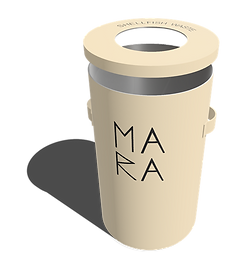


When designing the equipment, I needed to consider every stage of the user journey – from collection to production. I designed a shellfish collection bin, delivery box, and a material processing instruction manual.


The outcome of the Edinburgh-based system pilot is a resolved tableware set: a plate, side plate, bowl, and side bowl, speckled with local stories. The material shows noticeable pieces of aggregate that speak of local maritime heritage. The pieces are not just decorative - they are tangible markers of place, evoking local identity through connecting the land and sea.


MARA is an ongoing exploration of what design can be when it listens to place, values waste, and invites collaboration. This project doesn't end with a product, it begins with a system, open to evolution. The future of materials is circular.